






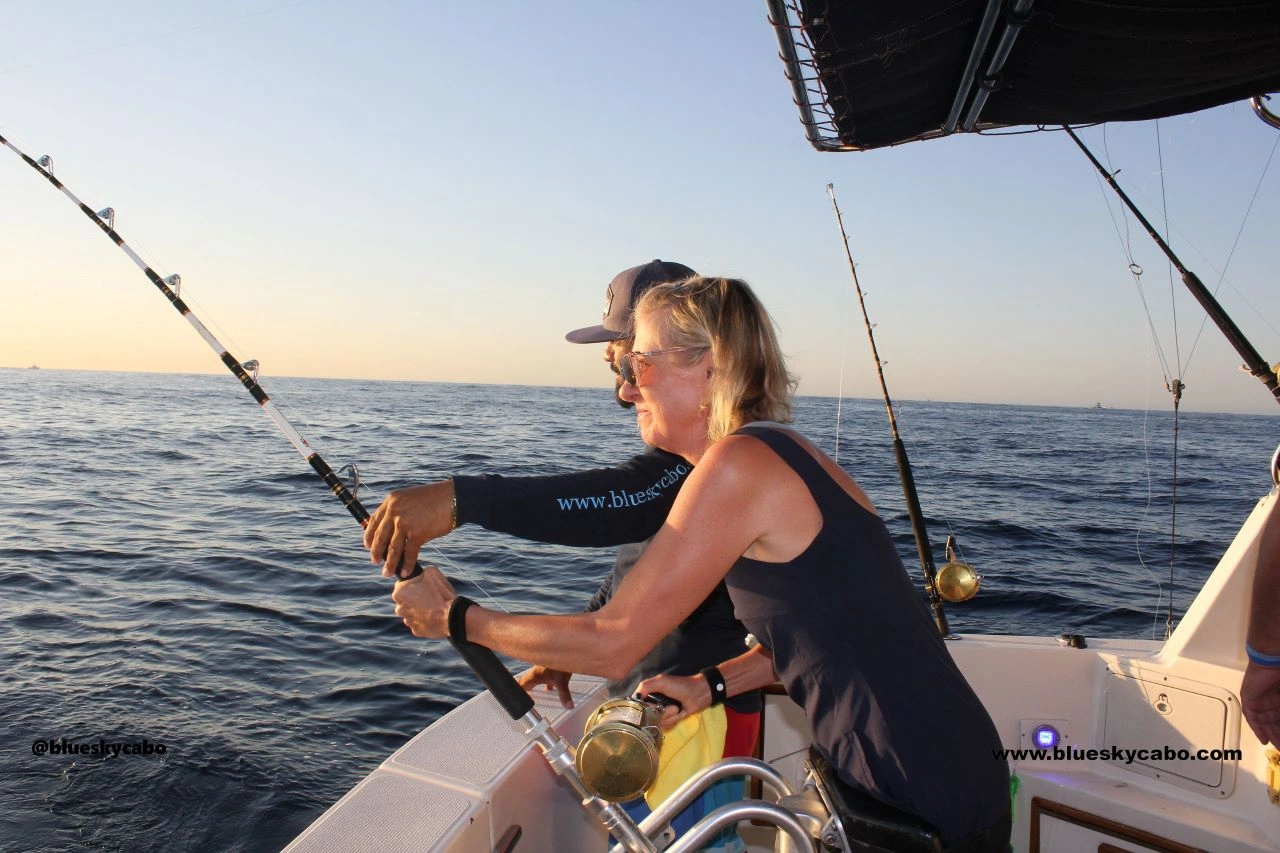
When most anglers picture yellowfin tuna fishing, they imagine long runs into the open ocean, distant offshore banks, porpoise schools on the horizon, and captains burning fuel while searching vast stretches of blue water. That image certainly describes many successful tuna trips around the world, but Cabo San Lucas has always played by a slightly different set of rules. The unique geography of Baja California Sur creates fishing opportunities that frequently surprise visiting anglers, which explains why one of the most common questions heard around the marina is Can You Catch Tuna Close to Shore in Cabo?
The answer is yes, although understanding why requires a closer look at what makes Cabo one of the most unique sportfishing destinations anywhere in the world.
Unlike many coastal fishing regions where deep water lies far offshore, Cabo benefits from underwater terrain that drops away rapidly. Productive blue water often begins much closer to land than visitors expect, allowing pelagic species to move surprisingly close to shore when conditions become favorable. This proximity creates opportunities that simply do not exist in many competing destinations because tuna, marlin, dorado, and other offshore predators can access productive feeding zones without needing to remain dozens of miles from land.
The result is a fishery where anglers occasionally find themselves battling tuna while still maintaining visual contact with Cabo’s famous coastline, something that first-time visitors often find difficult to believe until they experience it themselves.
Understanding Can You Catch Tuna Close to Shore in Cabo? begins with understanding how yellowfin tuna behave and why they move throughout the region. Tuna are not structure-oriented fish like grouper or snapper. They are highly migratory predators constantly searching for food. Their movements are influenced by bait concentrations, water temperatures, current systems, and feeding opportunities. Whenever those ingredients come together near Cabo, tuna frequently follow.
That simple relationship is what creates some of the most exciting surprises in Cabo fishing.
Why Deep Water Close to Shore Helps Tuna Fishing in Cabo
One of the greatest advantages enjoyed by anglers fishing Cabo is the remarkable proximity of deep water. In many fisheries, boats must travel significant distances before reaching depths capable of supporting large pelagic species. Cabo offers a very different scenario because deep water begins relatively close to shore, creating immediate access to environments where tuna naturally thrive.
This geographic advantage influences nearly every aspect of offshore fishing.
Captains spend less time traveling and more time fishing. Anglers remain engaged because the action can begin sooner. Offshore species gain access to productive water much closer to land than would normally be expected.
This is one of the primary reasons Can You Catch Tuna Close to Shore in Cabo? receives a positive answer more often than anglers anticipate.
When productive currents, favorable temperatures, and abundant bait become concentrated near the coastline, tuna have no reason to remain far offshore. They simply move toward the food source, creating opportunities for anglers who may have expected a much longer run.
Visitors are frequently surprised when the captain begins deploying lines earlier than expected because they are still admiring the shoreline. Then a tuna strikes, and suddenly the conversation shifts from scenery to fishing.
How Baitfish Determine Whether Tuna Stay Close to Shore
If there is one rule that consistently applies to yellowfin tuna, it is that they spend their lives chasing food. Their location on any given day is often determined by bait activity, which means successful captains spend a tremendous amount of time studying bait patterns rather than simply searching randomly.
Sardines, mackerel, skipjack, squid, flying fish, and numerous other forage species move throughout Cabo’s waters throughout the year. Whenever those baitfish become concentrated in productive areas, predators begin gathering nearby.
Tuna are among the most aggressive participants in that process.
This relationship explains a large portion of the answer to Can You Catch Tuna Close to Shore in Cabo? because tuna are not intentionally seeking the shoreline. They are following feeding opportunities. When bait becomes abundant near land, tuna often arrive shortly afterward.
Experienced captains understand this relationship extremely well. They monitor bird activity, study sonar readings, evaluate water color changes, and observe every environmental clue available because those clues frequently reveal where bait is gathering.
The fish are following the bait.
The captains are following the fish.
That chain reaction creates some of Cabo’s most productive tuna fishing opportunities.
Why Summer Water Temperatures Improve Tuna Opportunities
Although yellowfin tuna can be encountered during multiple periods of the year, warmer months frequently create some of the most exciting opportunities.
As water temperatures increase, offshore productivity often improves as well. Bait populations become more active, pelagic species move through the region in greater numbers, and feeding opportunities expand. During these periods, tuna can become increasingly accessible depending upon where productive water develops.
Many anglers researching Can You Catch Tuna Close to Shore in Cabo? are pleasantly surprised to learn that summer sometimes produces situations where schools of yellowfin move much closer to land than expected. These opportunities do not occur every day, and they certainly cannot be guaranteed, but they happen often enough that experienced captains remain alert for them throughout the season.
The exciting part is that summer rarely revolves around a single species.
An angler may leave the marina hoping for tuna and encounter marlin. Another may begin the day targeting marlin and end up fighting yellowfin. The diversity of the fishery creates a level of unpredictability that keeps every trip interesting.
This variety is one reason Cabo remains such a popular destination among repeat visitors.
Can You Catch Tuna Close to Shore in Cabo During the Fall Fishing Season?
As summer gradually transitions toward fall, many captains consider the fishery to be entering one of its most productive and exciting phases. Water temperatures often remain favorable, bait concentrations continue supporting predator activity, and offshore conditions create opportunities across multiple species.
For tuna anglers, this period can be particularly interesting because the combination of bait and warm water frequently produces active feeding conditions. While tuna may still roam broad sections of the fishery, they occasionally become accessible much closer to Cabo than newcomers expect.
This seasonal pattern contributes significantly to the answer behind Can You Catch Tuna Close to Shore in Cabo? because fall often demonstrates just how dynamic the fishery can be.
One week the fish may be farther offshore.
The next week they may be significantly closer.
The ocean is constantly changing, and successful captains adapt accordingly.
Why Tuna Have Become One of Cabo’s Most Popular Target Species
While marlin often dominate marketing materials and vacation photographs, yellowfin tuna have quietly developed one of the most loyal followings in all of offshore fishing.
The reason becomes obvious shortly after the first hookup.
Yellowfin tuna are powerful, relentless, and remarkably determined. Even relatively modest-sized fish can create battles that leave anglers exhausted. Larger tuna elevate that challenge dramatically, creating fights that become the highlight of an entire vacation.
This reputation helps explain why so many visitors become interested in Can You Catch Tuna Close to Shore in Cabo? because the possibility of battling one of these fish without requiring an all-day offshore expedition is extremely appealing.
The attraction extends beyond the fight itself.
Tuna also happen to be among the most respected table fish in the world, creating an additional reward for anglers who enjoy fresh seafood after a successful day on the water.
Why Porpoise Activity Often Helps Answer Can You Catch Tuna Close to Shore in Cabo?
One of the most interesting aspects of yellowfin tuna fishing is that successful captains are often searching for much more than tuna themselves. Throughout the Eastern Pacific, yellowfin tuna have long been associated with porpoise schools, and experienced crews routinely pay close attention whenever they observe active porpoise working an area because those animals frequently provide valuable clues regarding feeding activity below the surface.
The relationship is not accidental. Both species are often attracted to productive feeding zones where bait becomes concentrated. When porpoise activity increases, captains immediately begin gathering additional information because tuna may be nearby. Birds diving aggressively, baitfish scattering, surface disturbances, and sonar readings all become pieces of a larger puzzle that helps determine whether a productive feeding event is developing.
This is another reason Can You Catch Tuna Close to Shore in Cabo? cannot be answered using mileage alone. Productive feeding activity can develop surprisingly close to Cabo under the right conditions. Whenever bait, currents, and favorable water temperatures combine near shore, tuna and porpoise may appear much closer to land than anglers expect.
The best captains spend their days reading these clues rather than simply running to predetermined locations. That ability to interpret changing conditions is often the difference between an average day and a memorable one.
How Tuna Size Influences How Close to Shore They Are Found
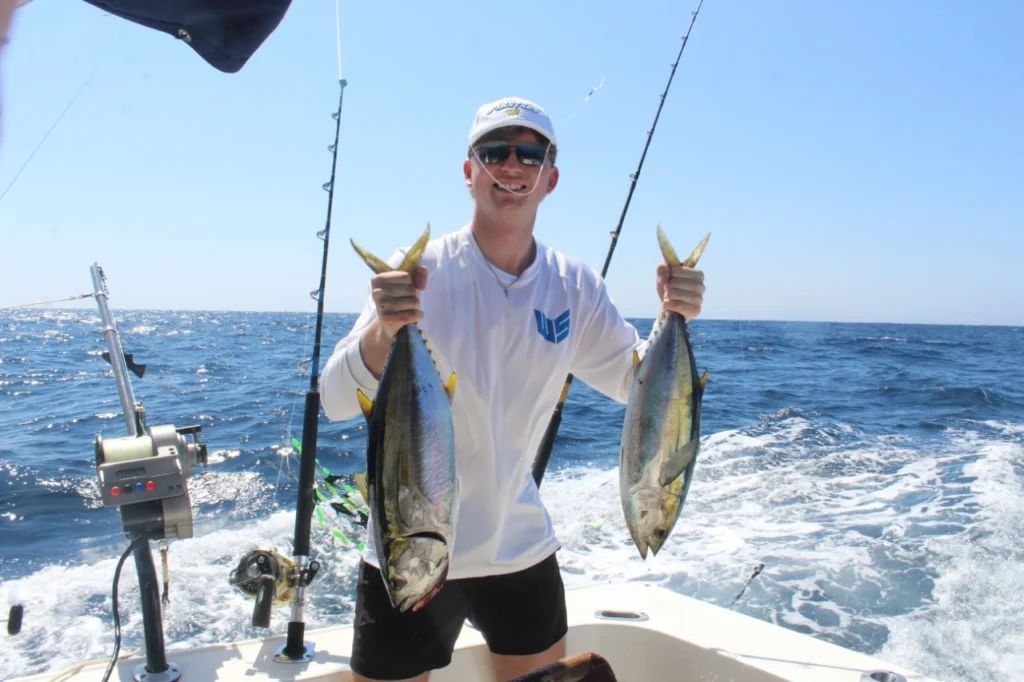
One factor that many anglers overlook when discussing tuna location is fish size. Smaller tuna often behave differently than larger fish, which means the answer to Can You Catch Tuna Close to Shore in Cabo? can vary depending on what size fish someone hopes to catch.
School-sized yellowfin and football tuna frequently move through productive feeding areas while searching aggressively for bait. During certain seasons these fish may become surprisingly accessible, creating exciting action for families, beginners, and anglers who simply enjoy constant activity.
Larger tuna often require a more specialized approach.
Fish exceeding one hundred pounds, and especially those pushing toward two hundred pounds or more, generally encourage captains to focus on specific offshore conditions where trophy-class yellowfin are more likely to be feeding. That does not mean giant tuna cannot appear closer to shore, because the ocean rarely follows rigid rules, but larger fish often demand a more targeted search.
This distinction helps explain why different anglers sometimes receive different answers when asking about tuna location. Someone targeting action may find excellent opportunities relatively close to Cabo, while someone pursuing a trophy-class yellowfin may be willing to travel farther if conditions justify the effort.
Fortunately, Cabo’s fishery offers opportunities for both approaches.
Why Water Color and Current Lines Affect Tuna Fishing Near Cabo
Experienced offshore fishermen often talk about water color as though they are discussing a living thing, and in many ways they are. Different water masses carry different temperatures, nutrient levels, bait concentrations, and feeding opportunities. When these water masses meet, they often create current lines that attract life throughout the food chain.
Yellowfin tuna pay close attention to these transitions.
Productive current lines frequently concentrate baitfish, creating feeding opportunities that predators quickly exploit. Captains spend significant time searching for these conditions because they understand how influential they can be.
This relationship contributes directly to the answer behind Can You Catch Tuna Close to Shore in Cabo? because current lines occasionally develop surprisingly close to land. When that happens, bait accumulates, predators arrive, and fishing opportunities can become exceptional without requiring long offshore runs.
Visitors often focus on distance because it is easy to measure. Professional captains focus on conditions because conditions determine where fish will actually be found.
That difference in perspective is one reason experienced crews consistently locate fish more effectively than anglers relying solely on assumptions.
Can You Catch Tuna Close to Shore in Cabo During Multi-Species Fishing Trips?
One of the advantages of fishing Cabo is that many offshore trips are not limited to a single target species. The region supports such a diverse fishery that anglers frequently pursue multiple opportunities during the same charter.
A day may begin with marlin trolling.
Tuna suddenly appear.
Dorado move into the spread.
Wahoo become active.
The entire plan changes.
This flexibility makes the answer to Can You Catch Tuna Close to Shore in Cabo? even more appealing because anglers do not necessarily need to dedicate an entire trip exclusively to tuna. Productive opportunities may develop naturally while targeting other species, especially during periods when bait concentrations are supporting multiple predators simultaneously.
Many memorable tuna catches occur this way.
An angler boards the boat hoping to catch marlin and returns to the dock discussing yellowfin tuna instead. The unpredictability of Cabo’s fishery is part of its charm because every trip carries possibilities that cannot be fully anticipated.
That uncertainty keeps things exciting even for repeat visitors who have fished the region many times before.
Why Cabo San Lucas Fishing Helps Anglers Understand Tuna Movements
Successful tuna fishing involves much more than choosing a date and hoping for the best. Seasonal patterns, bait activity, water temperatures, current systems, and offshore conditions all influence where fish may be located on any particular day.
Cabo San Lucas Fishing helps anglers understand:
- Tuna migration patterns
- Seasonal fishing opportunities
- Water temperature changes
- Offshore fishing reports
- Bait activity trends
- Productive fishing techniques
- Charter-planning strategies
This information helps visitors understand why tuna may appear surprisingly close to shore during some periods while remaining farther offshore during others. The more anglers understand the fishery, the easier it becomes to appreciate the factors driving fish movement throughout the region.
Knowledge does not eliminate uncertainty, but it certainly helps explain it.
The Real Answer to Can You Catch Tuna Close to Shore in Cabo?
After examining water temperatures, bait concentrations, porpoise activity, current lines, fish size, seasonal changes, and offshore conditions, the answer becomes remarkably straightforward.
Can You Catch Tuna Close to Shore in Cabo?
Absolutely.
The reason Cabo is such a unique tuna destination is because deep water approaches the coastline much faster than many anglers expect, creating opportunities that simply do not exist in numerous other fisheries. Whenever bait becomes concentrated near shore and favorable conditions develop, yellowfin tuna frequently take advantage of those feeding opportunities.
That does not mean tuna will always be close.
Some days require longer searches.
Some seasons produce more offshore activity.
Some conditions encourage fish to roam farther from land.
The important point is that anglers should never assume tuna automatically require a long offshore journey when fishing Cabo. The fish respond to food, water conditions, and opportunity, and sometimes those ingredients come together surprisingly close to the marina.
For visiting anglers, that reality creates one of the most enjoyable aspects of Cabo fishing because every trip begins with genuine possibility. A captain may leave the dock expecting one scenario and discover something entirely different a short time later. That flexibility, combined with the remarkable productivity of the region, helps explain why Cabo remains one of the world’s premier destinations for yellowfin tuna.
And for anyone still wondering Can You Catch Tuna Close to Shore in Cabo?, the answer remains a very enthusiastic yes, provided the bait, conditions, and fish all decide to cooperate on the same day.