







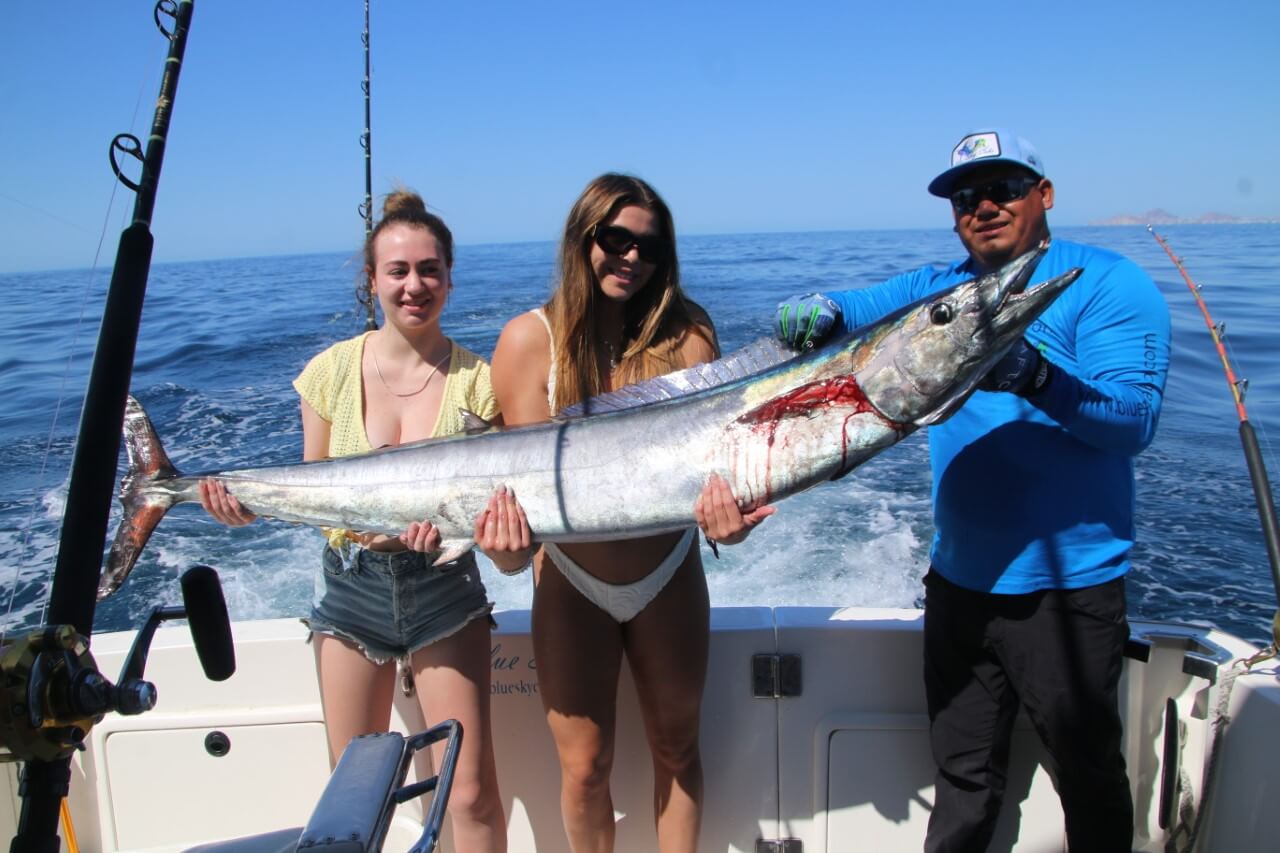
The best time of day to fish in Cabo is generally early morning, particularly from sunrise through the first several hours of daylight, but that does not mean productive Cabo fishing ends when the morning bite slows. Offshore species such as striped marlin, blue marlin, yellowfin tuna, dorado, and wahoo can feed throughout the day, while inshore species including roosterfish, sierra mackerel, snapper, and grouper respond differently according to tide, bait movement, current, water temperature, and seasonal conditions. For most anglers booking a Cabo fishing charter, an early departure provides the greatest flexibility because the boat can take advantage of cooler conditions, active bait, morning feeding patterns, and a full fishing window before returning to the Cabo San Lucas Marina.
The more complete answer is that there is no universal hour when every species suddenly begins feeding. Cabo San Lucas fishing takes place where the Pacific Ocean meets the southern Baja Peninsula and the Sea of Cortez, creating a remarkably dynamic marine environment. Offshore currents, underwater banks, deep canyons, bait schools, tides, wind, sunlight, water clarity, and temperature breaks can influence the bite as much as the clock.
That is why experienced Cabo captains think in terms of fishing conditions and opportunities, not simply morning versus afternoon.
A 6:00 AM departure may be ideal for one target, while a tuna school discovered at 11:30 AM can turn late morning into the most productive part of the trip. Marlin may suddenly begin feeding beneath birds after several quiet hours. Dorado can appear around floating debris in the middle of the afternoon.
For anglers planning a Cabo San Lucas fishing charter, departure time matters, but flexibility matters even more.
What Is the Best Time of Day for a Cabo Fishing Charter in Cabo San Lucas?
For most offshore trips, early morning is the best starting time for fishing in Cabo San Lucas.
Leaving the marina around sunrise provides several advantages. Air temperatures are cooler, winds are frequently lighter, fishing grounds can be reached early, and captains have more hours available to locate productive water.
Morning also gives crews the opportunity to obtain live bait and immediately begin searching.
This is particularly important because successful offshore fishing is rarely about arriving at one predetermined GPS coordinate and waiting. A captain may need to investigate several locations before finding bait, birds, current edges, temperature breaks, porpoise, floating debris, or feeding predators.
An early departure effectively gives the crew a larger decision-making window.
If the first area is unproductive, there is time to move.
If tuna are reported farther offshore, there may still be time to reach them.
If marlin are concentrated around a bank, the crew can remain with the fish longer.
For that reason, experienced anglers often view fishing time as one of the most valuable assets on a charter.
Cabo Fishing Charter Time-of-Day Grid
The following grid provides a practical comparison of typical Cabo fishing conditions throughout the day. These ratings are general planning guidelines rather than guarantees because daily ocean conditions ultimately determine fish behavior.
| Time of Day | Fishing Potential | Typical Conditions | Strong Opportunities |
| 5:30–7:00 AM | Excellent | Low light, cooler air, early bait activity | Bait collection, inshore species, offshore start |
| 7:00–9:00 AM | Excellent | Increasing light, often manageable wind | Marlin, tuna, dorado, roosterfish |
| 9:00–11:00 AM | Excellent | Established offshore activity | Marlin, tuna, dorado, wahoo |
| 11:00 AM–1:00 PM | Very Good | Brighter sun, changing wind | Tuna, marlin, dorado |
| 1:00–3:00 PM | Good–Very Good | Warmer conditions, possible afternoon breeze | Marlin, dorado, tuna |
| 3:00 PM–Sunset | Variable–Good | Changing light, afternoon conditions | Inshore predators, dorado, opportunistic pelagics |
This grid demonstrates an important point: morning provides an excellent starting advantage, but Cabo fishing can remain productive well beyond breakfast.
Cabo Fishing Charter Daily Fishing Opportunity Graph
The daily pattern can also be viewed by comparing the major fishing periods and the conditions they typically offer.
| Fishing Factor | Sunrise–8 AM | 8–11 AM | 11 AM–2 PM | 2 PM–Sunset |
| Overall Fishing Opportunity | ★★★★★ | ★★★★★ | ★★★★☆ | ★★★☆☆ |
| Comfort / Cooler Conditions | ★★★★★ | ★★★★☆ | ★★★☆☆ | ★★★☆☆ |
| Offshore Searching Time Available | ★★★★★ | ★★★★★ | ★★★☆☆ | ★★☆☆☆ |
| Live-Bait Opportunity | ★★★★★ | ★★★★☆ | ★★★☆☆ | ★★★☆☆ |
| Marlin Potential | ★★★★☆ | ★★★★★ | ★★★★★ | ★★★★☆ |
| Tuna Potential | ★★★★☆ | ★★★★★ | ★★★★★ | ★★★★☆ |
| Dorado Potential | ★★★★☆ | ★★★★★ | ★★★★★ | ★★★★☆ |
| Inshore Opportunity | ★★★★★ | ★★★★☆ | ★★★☆☆ | ★★★★☆ |
The biggest advantage of an early departure is therefore not that fish stop biting later. It is that anglers gain more usable time to locate the best Cabo fishing conditions.
Why Early Morning Is Excellent for a Cabo Fishing Charter
Sunrise has long been associated with productive saltwater fishing, and there are practical reasons behind that reputation.
Reduced light can encourage predators to feed aggressively because baitfish have less visual protection. Surface temperatures are cooler. Inshore bait may be concentrated near beaches, rocky points, reefs, or current boundaries.
Morning can also provide favorable conditions for spotting surface activity.
Birds working over bait become valuable indicators. Surface-feeding fish can reveal themselves. Marlin fins may become visible. Porpoise activity can direct boats toward yellowfin tuna.
The first few hours also give captains time to establish what the ocean is doing that day.
That information becomes increasingly valuable as the charter progresses.
Cabo Fishing Charter Morning Conditions and Wind
Another major reason to begin early is wind.
Cabo frequently experiences calmer morning conditions before localized winds strengthen later in the day. This is not an absolute rule, and weather patterns change by season, but earlier departures often provide more comfortable running conditions.
This matters considerably offshore.
A boat searching San Jaime Bank, Golden Gate Bank, the 1150 Bank, Gordo Banks, Cabo Falso, or distant current lines may travel many miles.
Lighter morning wind can make those runs more comfortable and allow crews to troll efficiently once they arrive.
Comfort should not be underestimated.
A guest who is comfortable can remain engaged with the fishing longer, while rougher afternoon conditions may make an otherwise productive charter less enjoyable.
Cabo Fishing Charter Morning Live-Bait Advantage
Live bait can be extremely valuable when fishing Cabo waters.
Depending on season and availability, crews may use bait such as caballito, mackerel, sardines, or other locally available forage species.
Beginning early allows a charter to secure bait and reach productive fishing grounds without sacrificing the middle portion of the day.
For striped marlin, live bait can be particularly valuable when fish are spotted on the surface.
For roosterfish, live bait presented near beaches and inshore structure can produce explosive strikes.
For yellowfin tuna, bait may become part of a broader strategy involving porpoise schools, chum, trolling, casting, or kite presentations.
The important factor is arriving prepared while sufficient fishing time remains.
Cabo Fishing Charter Best Time for Marlin Fishing
The best time of day for marlin fishing in Cabo San Lucas is not restricted to sunrise.
This is an important distinction.
Marlin are highly mobile predators capable of feeding throughout daylight hours. A quiet morning can transform rapidly if the boat finds a concentrated bait school at noon.
Striped marlin may be observed tailing or cruising near the surface as sunlight increases and conditions make the fish easier to spot.
This can actually make late morning extremely productive.
Captains and mates watch for fins, tails, birds, bait, current lines, and surface disturbances. Once a marlin is located, live bait can be presented directly to the fish.
For blue marlin, trolling throughout productive offshore water can generate strikes at virtually any daylight hour.
Therefore, anglers should avoid assuming that a marlin charter is unsuccessful simply because the first two hours are quiet.
The next pass can change everything.
Cabo Fishing Charter Best Time for Yellowfin Tuna
Yellowfin tuna fishing in Cabo demonstrates perfectly why the clock is only one variable.
Tuna activity is often connected to porpoise, bait concentrations, underwater structure, current, and water temperature.
A captain may spend several hours locating the right porpoise school.
Once found, the action can become intense regardless of whether it is 8:00 AM or noon.
Tuna can be targeted using:
- Live bait around active schools.
- Trolling cedar plugs and tuna lures.
- Casting toward breaking yellowfin.
- Following porpoise schools holding tuna.
- Working offshore banks and temperature breaks.
- Using kite fishing techniques when appropriate.
- Deploying artificial flying-fish presentations.
- Watching birds for concentrated bait activity.
This is why additional charter time can be particularly valuable for dedicated tuna anglers.
Finding the school is often the hardest part.
Cabo Fishing Charter Best Time for Dorado
Dorado fishing in Cabo San Lucas can remain productive throughout much of the day.
These brightly colored predators are frequently associated with floating debris, weed lines, current edges, bait concentrations, and temperature changes.
Morning can certainly produce excellent dorado action, but midday sunlight can also make floating structure easier to see.
A small piece of debris can hold an entire miniature ecosystem.
Baitfish gather beneath it. Dorado arrive to feed. Larger predators may investigate the same structure.
Once a dorado is hooked, additional fish frequently remain nearby, creating opportunities for multiple hookups.
Because of this behavior, finding productive floating structure can be more important than fishing at one particular hour.
Cabo Fishing Charter Best Time for Wahoo
Wahoo are among the fastest and most aggressive offshore predators encountered around Cabo.
They frequently respond well to trolling and can strike at different times throughout the day.
Morning is often attractive because crews can begin searching productive banks and current edges early, but water conditions and bait remain more important than an exact hour.
Wahoo are particularly associated with seasonal warm-water periods and can be encountered around structure, temperature changes, and productive offshore zones.
Fast trolling, diving plugs, artificial lures, and rigged baits can all play a role depending on the captain’s strategy.
A wahoo strike often happens suddenly.
That unpredictability is part of what makes Cabo offshore fishing exciting.
Cabo Fishing Charter Best Time for Roosterfish
For anglers interested in inshore fishing, early morning can become even more valuable.
Roosterfish patrol beaches, rocky points, and nearshore structure, searching for bait.
Lower morning light and cooler conditions can create productive opportunities before boat traffic and bright midday conditions increase.
Live bait can be slow-trolled or presented around likely areas while the captain watches for feeding fish.
Roosterfish are powerful inshore predators recognized by their distinctive dorsal fin and tremendous fighting ability.
They are also commonly treated as a catch-and-release sport fish, making proper handling important.
For visitors who prefer staying closer to shore, a morning roosterfish trip can provide an entirely different experience from offshore marlin or tuna fishing.
Cabo Fishing Charter Best Time for Sierra, Snapper and Grouper
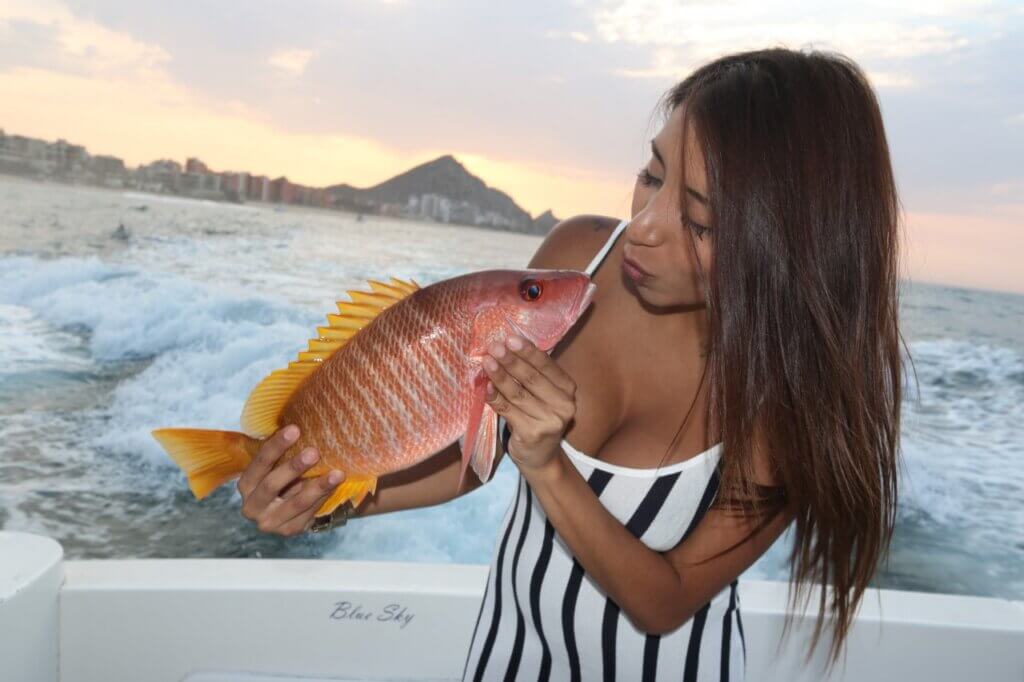
Morning can also benefit anglers targeting sierra mackerel, snapper, and grouper.
Sierra often hunt actively around bait concentrations and can provide fast action on lighter tackle.
Snapper and grouper are more closely connected to bottom structure, reefs, rocky areas, and depth changes.
For these species, tide and current can sometimes matter more than sunlight.
A productive tidal movement may activate fish at 10:30 AM even if sunrise produced little action.
This illustrates why experienced captains consider several variables simultaneously.
The clock provides context.
The ocean provides the actual answer.
How Cabo Fishing Charter Tides Affect the Best Time of Day
Tides deserve attention when determining the best fishing time in Cabo.
Moving water can reposition bait, activate predators, and change how fish relate to beaches, reefs, rocks, banks, and current edges.
This can be especially important for inshore species.
A favorable tide may occur early in the morning one day and several hours later the following week.
Consequently, the “best time” can move.
Offshore species are generally less directly controlled by shoreline tidal movements, but currents remain extremely important.
The broader lesson is simple: fishing conditions should determine strategy rather than an arbitrary clock time.
Cabo Fishing Charter Water Temperature and Time of Day
Water temperature is another major component of Cabo fishing success.
Seasonal temperature changes influence which species are present far more dramatically than small temperature fluctuations between morning and afternoon.
Striped marlin are commonly associated with cooler seasonal conditions.
Blue marlin and black marlin become increasingly relevant as offshore waters warm.
Dorado, yellowfin tuna, and wahoo also respond to seasonal warm-water patterns.
For this reason, captains pay particular attention to temperature breaks where two bodies of water meet.
Those boundaries can concentrate bait and create productive fishing zones.
Finding a strong temperature break at noon can be much more valuable than fishing unproductive water at sunrise.
Cabo Fishing Charter Locations and Morning Departure Advantages
The southern Baja Peninsula offers access to numerous famous fishing grounds, but each requires travel time.
Depending on the season and current activity, captains may consider Cabo Falso, San Jaime Bank, Golden Gate Bank, Finger Bank, the 1150 Bank, Gordo Banks, Cardonal Canyon, and offshore current or temperature boundaries.
An early departure increases the number of options available.
If the fish are close to shore, the crew can capitalize immediately.
If reports indicate activity farther offshore, the captain has enough remaining time to travel.
This is one reason an early start and longer charter can work extremely well together.
Time creates range.
Range creates options.
Options allow captains to react to changing Cabo fishing conditions.
Is Noon Too Late for a Cabo Fishing Charter?
No.
Noon is not automatically too late to catch fish in Cabo San Lucas.
Some outstanding catches occur around midday.
Marlin may become easier to spot near the surface. Tuna can begin feeding aggressively around porpoise. Dorado can suddenly appear along a current line. Offshore bait may become concentrated by moving water.
What changes is the amount of fishing time remaining.
A boat beginning its trip at noon has fewer hours available to search distant areas before sunset or the scheduled return.
This is why morning departures are generally recommended for serious offshore anglers even though fish continue feeding later.
The advantage is opportunity, not a magical sunrise bite.
Are Afternoon Cabo Fishing Charters Worthwhile?
An afternoon Cabo fishing charter can absolutely be worthwhile.
Vacation schedules do not always allow an early departure, and some guests prefer a relaxed morning followed by several hours on the water.
Afternoon fishing can also be productive when conditions cooperate.
A captain may already know where fish were located during the morning. Current information from other boats can reduce searching time. Late-day tidal movement may activate inshore predators.
However, afternoon wind should be considered, particularly during seasons when local breezes strengthen later in the day.
For serious offshore fishing, morning generally offers greater strategic flexibility.
For recreational fishing, family trips, and guests balancing multiple vacation activities, an afternoon charter can still provide an excellent Cabo experience.
How Long Should a Cabo Fishing Charter Be?
The ideal charter duration depends on the angler’s goals.
A shorter trip works well for families, first-time anglers, or visitors who want to combine fishing with other Cabo activities.
A six-hour fishing charter provides more searching time and allows the captain to reach a broader selection of fishing grounds.
An eight-hour charter gives dedicated anglers significantly more flexibility.
Longer offshore days become particularly valuable when pursuing marlin, tuna, wahoo, or other highly mobile pelagic species.
The farther fish move from Cabo, the more important charter duration becomes.
Additional hours do not guarantee additional fish.
They provide additional decisions.
That distinction matters.
Cabo Fishing Charter Time and Trip Planning Grid
| Fishing Goal | Recommended Start | Useful Duration | Primary Advantage |
| First-Time Cabo Fishing | Early Morning | 5–6 Hours | Comfortable introduction |
| Striped Marlin | Early Morning | 6–8 Hours | More searching flexibility |
| Blue Marlin | Early Morning | 8+ Hours | Greater offshore range |
| Yellowfin Tuna | Early Morning | 6–10 Hours | Time to locate schools |
| Dorado | Morning | 5–8 Hours | Flexible offshore search |
| Roosterfish | Early Morning | 5–6 Hours | Productive inshore conditions |
| Family Fishing | Morning | 5 Hours | Cooler and comfortable |
| Mixed-Species Offshore | Early Morning | 8 Hours | Maximum adaptability |
Why Longer Cabo Fishing Charters Can Outperform Short Trips
Imagine two boats leaving Cabo at the same time.
Both search the same initial area and find little activity.
After several hours, reports begin indicating tuna or marlin farther offshore.
The longer charter can investigate.
The shorter charter may already need to begin traveling back toward the marina.
This does not mean longer charters always catch more fish, but they provide captains with something extremely valuable: freedom.
Freedom to search.
Freedom to move.
Freedom to wait.
Freedom to follow changing conditions.
For serious anglers, those additional options can be more important than choosing between 6:00 AM and 7:00 AM.
How Cabo Fishing Charter Captains Decide When and Where to Fish
An experienced Cabo fishing charter captain combines multiple pieces of information before deciding where to spend the day.
The process begins before lines ever enter the water.
Recent fishing reports matter.
Water temperatures matter.
Bait availability matters.
Wind direction, current, tides, moon conditions, offshore structure, bird activity, and reports from other boats can all contribute.
Once offshore, direct observation becomes even more important.
A captain is constantly looking for signs.
Birds diving. Porpoise moving rapidly. Flying fish leaving the surface. Marlin tails. Floating debris. Color changes. Current seams. Bait on electronics. Surface disturbances.
Every clue helps build a picture.
The best time of day becomes the moment when those pieces finally come together.
What Is the Best Time of Day to Fish in Cabo for the Greatest Opportunity?
For most visitors, early morning remains the best overall time to begin fishing in Cabo San Lucas.
A sunrise departure provides cooler temperatures, frequently favorable sea conditions, early access to live bait, and—most importantly—the greatest amount of remaining daylight to search productive water.
But starting early should never be confused with believing the fish only bite early.
Marlin can strike at noon. Yellowfin tuna can erupt beneath porpoise late in the morning. Dorado can attack around floating debris during the afternoon. Roosterfish can become active when a favorable tide develops.
The ocean does not operate according to a tourist schedule.
That is what makes Cabo San Lucas fishing so fascinating.
The best strategy is to begin early, choose enough charter time for the target species, and allow an experienced captain to respond to what the Pacific Ocean and Sea of Cortez are actually doing.
For a serious offshore angler, that combination is difficult to improve upon: an early Cabo fishing charter departure, sufficient fishing time, quality bait and tackle, an adaptable crew, and the freedom to follow productive water wherever the day’s conditions lead.
When all of those factors come together, the best time of day to fish in Cabo is no longer simply an hour on the clock.
It is the moment the crew finds the right water, the right bait, and the right fish.
Cabo San Lucas Fishing Charter Company
Website – Cabo San Lucas Fishing
YouTube Shorts Channel Videos
Dock Address – F Dock, Centro, Marina, Cabo San Lucas, B.C.S., Mexico
